
Image

A ski resort running on renewable energy
Image

Built on a sustainable tourism Masterplan
Image
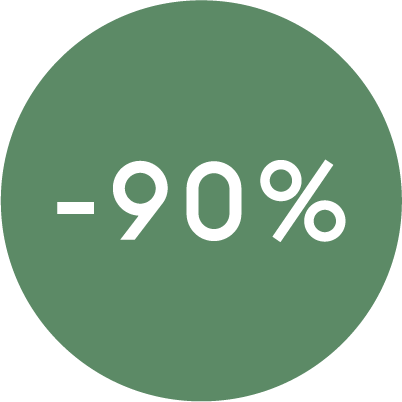
Reduction of CO₂ emissions since 2008
Image

Committed to the EU Energy Efficiency Agreement
Long-term development
We have been developing Ruka Ski Resort through sustainable choices for over 70 years. In 2002, we began implementing a Master Plan, created in collaboration with the Canadian planning firm Ecosign Mountain Planners, based on the most efficient land use. We are also among the first ski resorts in the world to introduce an environmental program (in 2008).
Our long-term environmental work is reflected in actions across our entire operation, from construction to emissions reduction.
Climate actions and energy efficiency
The main goal of Ruka’s sustainability work is to ensure that future generations can also enjoy skiing and the joy of snow. The most significant measure in achieving this has been a commitment to the use of renewable energy sources. We have used electricity and district heating produced from renewable resources since 2008. We introduced renewable biodiesel in 2021, and our first electric snowmobiles were launched in 2024. As a result of these measures, our direct and purchased energy CO₂ emissions have decreased by approximately 90% since 2008. In addition, we offset emissions from fossil fuel use as well as those generated by the ski bus and staff commuting.
Pioneer position and international commitments
It is important for us to act as a pioneers and encourage others towards responsible practices. Ruka and Pyhä were the first ski resorts in Finland to be awarded the Sustainable Travel Finland label. The program, managed by Business Finland, helps the tourism industry adopt responsible practices systematically and effectively.
In 2024, we joined the UN Global Compact corporate responsibility initiative, which brings together companies worldwide to build a sustainable future. Through this, our sustainability work is guided by global principles and the Sustainable Development Goals.
Circular Economy
We promote the circular economy primarily through our equipment rental and accommodation operations. Equipment rental significantly reduces the need for customers to purchase new gear. At Ruka, almost 80 000 pieces of equipment are rented annually.
In the Ski-Inn accommodation concept, the circular economy is realized by renting privately owned apartments when their owners are not using them. At the same time, this minimizes the environmental impacts of land use and construction, as well as unnecessary energy consumption.
We also promote the circular economy in our other operations. For example, we have introduced several used ski lifts into service. Furniture that becomes outdated during Ski-Inn apartment renovations is passed on for reuse. In our operational activities, various materials are reused whenever possible.
Responsible customer experience
We enable our customers to enjoy an environmentally responsible holiday by providing the conditions for a car-free stay at Ruka. Ski-Inn accommodations use renewable electricity and heating, and the slopes and services are within walking distance or accessible by lift from the accommodation. A low-emission skiing holiday at Ruka comes naturally: arrive by train, stay in a Ski-Inn property, and ski on slopes powered by renewable energy. Rukas’s Ski-Inn properties are Green Key certified.

Ruka Master Plan – the foundation of sustainable tourism
Ruka’s development has been based on a Master Plan created in collaboration with the Canadian firm Ecosign Mountain Planners since 2002. The plan aims to develop Ruka according to the principles of sustainable development. Key objectives of the Ruka Master Plan include:
- Attractive walkable villages and accessibility to slopes and year-round services without a car
- Minimizing land use and environmental impact
- Maximizing occupancy of accommodations – the so-called “hot beds”
Examples of development in line with the Ruka Master Plan include:
- Pedestrian village and Ski-Inn accommodations (around 2,500 beds)
- Gondola connecting RukaVillage and RukaValley, also serving as public transport between the villages
- Development of summer activities, including downhill biking, the Ruka Coaster, and zipline
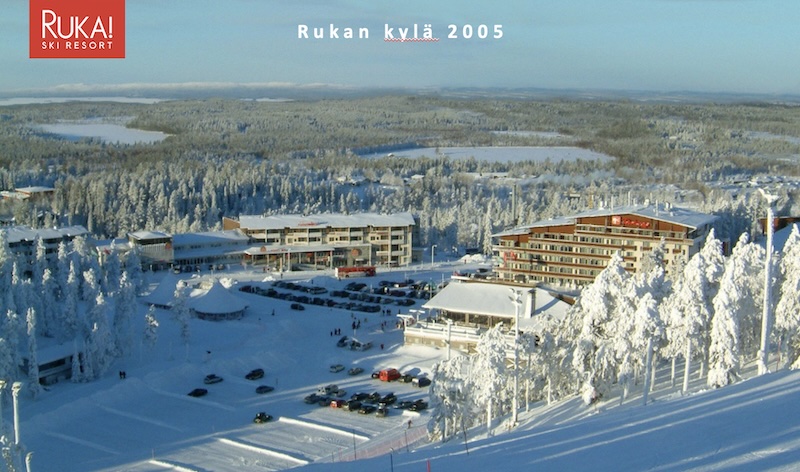
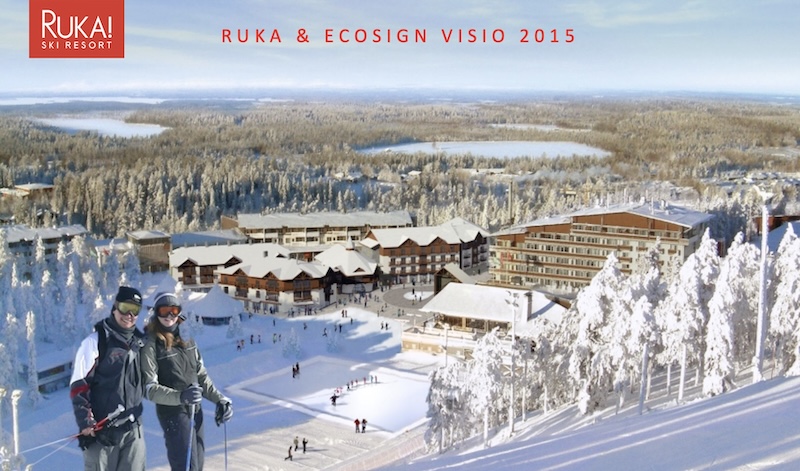
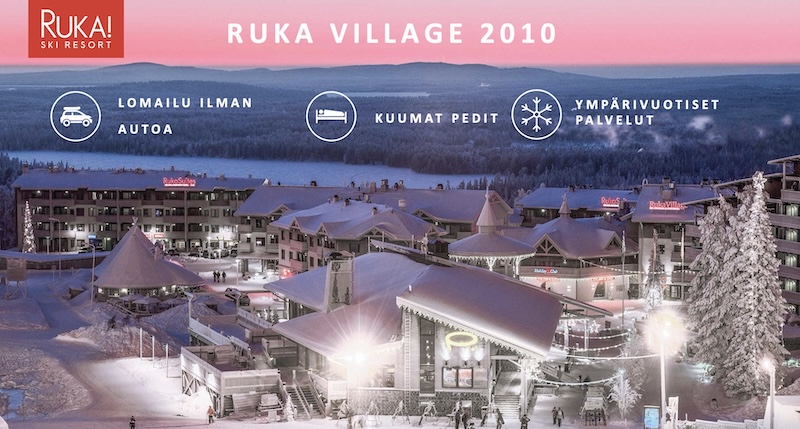
The image series below shows the development of the RukaVillage according to the principles of the Master Plan:
Climate change mitigation
Climate change is the most significant threat to snowy winters and ski resort operations. In 2008, we set a target to become a carbon-neutral ski resort in terms of our direct (Scope 1) and purchased energy emissions (Scope 2) by 2020. We reached this goal by switching to renewable electricity, district heating, geothermal heating, and biodiesel (for snow groomers), as well as offsetting emissions generated from the use of fossil fuels (snowmobiles, cars, and ATVs). In addition, we have offset emissions from staff work travels and the ski bus, which fall under Scope 3 emissions.
Due to changes in legislation, carbon offsetting is no longer officially accepted as a measure for achieving carbon neutrality targets. However, we have continued offsetting because it still contributes to mitigating climate change.
Over 97% of the emissions generated by our operations arise within our value chain (Scope 3 emissions). This calculation does not include emissions from customer travel, which are known to significantly increase the total amount of Scope 3 emissions. While we cannot directly influence how our customers travel, we encourage them to choose low-emission options whenever possible.
Of the calculated Scope 3 emissions, the most significant sources are purchases and investments, which account for nearly 80% of value chain emissions. Reducing these emissions is considerably more challenging than reducing Scope 1 and 2 emissions, as we cannot influence them solely through our own decisions. Nevertheless, we are committed to reducing Scope 3 emissions, with the goal of achieving significant reductions in these as well.
Energy efficiency
Improving energy efficiency, alongside reducing climate emissions, is one of the main goals of our environmental responsibility work. We joined the EU Energy Efficiency Agreement as early as 2008. The current agreement period runs until 2025, and the next will cover 2026–2035.
We focus on improving energy efficiency particularly in slope operations and buildings. Examples of the measures we have taken include:
- Investments in automated snowmaking systems
- Optimizing snowmaking through technology
- Expanding the use of LED lighting on slopes and in accommodation
- Optimizing slope lighting with smart technology
- Utilizing waste heat from snowmaking to heat buildings
- Adopting geothermal heating
- Optimizing snow groomer driving and training operators
- Introducing electric snowmobiles
- Adjusting lift speeds according to visitor numbers
- Adding heat recovery systems to older buildings
- Using Optiwatti smart energy management in Ski-Inn apartments
- Reducing water consumption in apartments
Ski-Inn is a Green Key certified accommodation option
Ruka and Pyhä Ski-Inn Hotels & Apartments were awarded the internationally recognised Green Key sustainability certification in spring 2025 as a recognition of our long-term and impactful sustainability work.
At Ski-Inn apartments, you can enjoy your holiday with peace of mind, as all the electricity and heating energy we use has been produced from renewable natural resources since 2008. The location of the apartments within walking distance of lifts and services enables car-free holidays year-round.
Ski-Inn apartments operate on an ownership model where privately owned holiday apartments are rented out year-round. This is an ecologically responsible choice, as it reduces land use and environmental impact by combining ownership and rental use. Read more >
All Ski-Inn apartments are equipped with recycling bins and instructions. At Ruka Ski-Inn apartments, guests can recycle bio waste, plastic, glass, small metal, cardboard and paper. Recycling points are located in the waste rooms of each property. Ski-Inn recycling instructions >
Rental bed linen and towels used in Ski-Inn apartments are certified with the Nordic Swan Ecolabel. Read more >
Cleaning of Ski-Inn apartments is provided by SOL. Learn more about their sustainability actions >